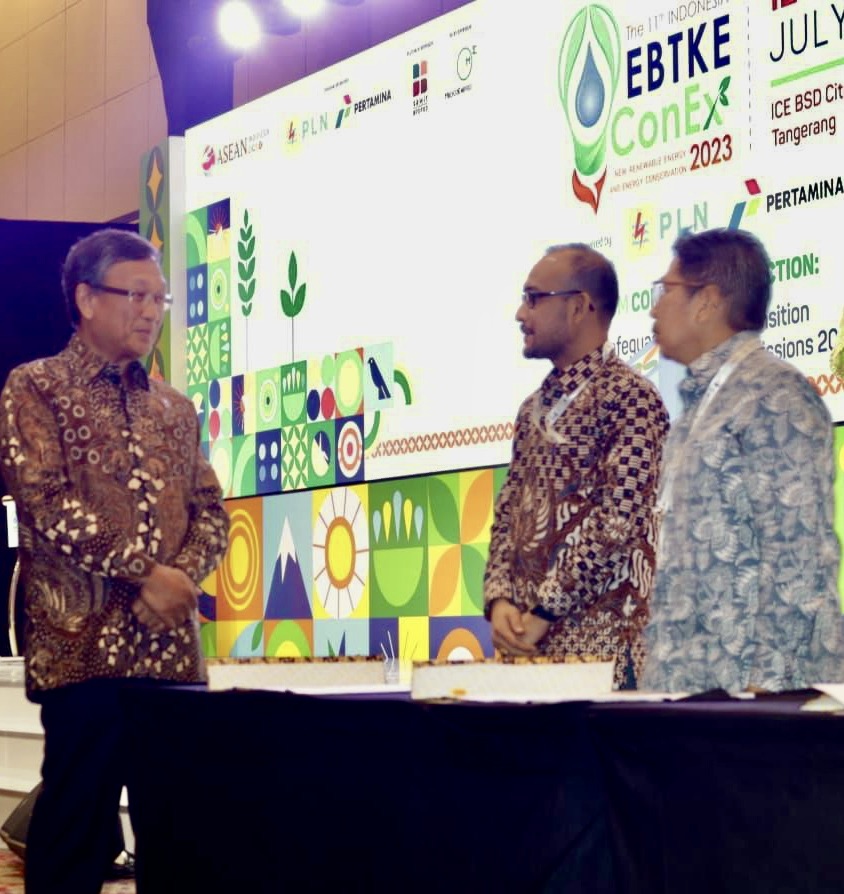
Kiri ke kanan: Arifin Tasrif (Menteri ESDM), Ali Mulyagusdin (Direktur PT PEMA), Julfi Hadi (Direktur PT Pertamina Geothermal Energy) — penandatanganan komitmen kerja sama pengembangan panas bumi Seulawah Agam, 12 Juli 2023.
AIL1This piece draws on an academic paper I wrote, “The Application of Balanced Scorecard in Business Model Canvas Model to Link The Sustainable Energy to Enterprise Strategies,” published in the proceedings of the 2016 Asian Alumni Workshop on Resilience in Energy System (Indonesian Alumni Association of the University of Flensburg, Germany), back when I was still at the UKM Center, USK's Faculty of Economics and Business. Ten years later, I've rewritten it for Aceh's current context. This piece comes in three parts. This is part one.
In 2016, I wrote about a simple unease: businesses almost never make energy sustainability a primary goal in their strategic planning. Globalization accelerates trade, accelerates economic growth between countries, and automatically accelerates energy consumption. But the balance sheet companies use to measure success is almost always just one thing: money.

The question back then: what tool could force sustainability to sit alongside profit on the same balance sheet?
The answer, in my view, lies in Kaplan and Norton's Balanced Scorecard (1996) linked to Osterwalder's Business Model Canvas. Ten years later, in Aceh, that question is no longer theoretical. Exploration wells have been drilled. Partners are already sitting at the table. The only thing still missing is a decision to actually use this framework in earnest.
Why a Balance Sheet That Only Talks About Money Is Dangerous
The Balanced Scorecard forces an organization to look at itself from four angles: Learning & Growth (the quality of its people and its learning culture), Business Process (the efficiency of internal processes), Customer (satisfaction and relevance to customers), and last, Financial. Kaplan and Norton argue that an organization chasing only the financial numbers will look healthy in this year's report, but hollowed out four or five years down the road, because investments in learning, process, and customers only show their impact later.
Sustainable energy faces exactly the same fate. Investment in geothermal, hydropower, or energy efficiency rarely wins in the annual budget meeting, because the payoff only shows up a decade later. The Business Model Canvas itself doesn't automatically solve this, it's just an empty canvas with nine blocks (key partners, key activities, value proposition, customer relationships, customer segments, key resources, channels, cost structure, revenue streams). Without a Balanced Scorecard placing sustainability as one of the mandatory balance sheets, that canvas will get filled in with the old logic: what matters is low cost and quick profit.
Destination Statement: Writing the Goal Before Writing the Strategy
The third generation of the Balanced Scorecard, according to Ronchetti (2006), has one important breakthrough: the Destination Statement. Rather than setting objectives first and only then working out what the organization will become, the third generation reverses the order: write first, in as much detail as possible, what this organization will look like at some point in the future. Only then are the strategic objectives derived from that.
This is what I think is most relevant today. “Zero Emission 2045” must not stop at being a campaign slogan or a line in a ceremonial speech. It has to be written as a Destination Statement: a target that binds every RKA (Work and Budget Plan), every partnership contract, and every business canvas of every BUMD in Aceh, starting now, not later.
Now: From Working Paper to Aceh's Map
What's changed over the past ten years isn't the theory, but the availability of the tools. Aceh holds 15 geothermal points, three of which already have Geothermal Working Area status and are ready for development. One of them, the Seulawah Agam Working Area, has potential of up to 320 MW based on early geoscience surveys, developed through a partnership between an Aceh BUMD and Pertamina Geothermal Energy, with two 55 MW geothermal power plant units targeted to begin commercial operation around 2032.
Compare this with ASEAN's target: the region is aiming for 23 percent renewable energy in its primary energy mix and 35 percent in its power capacity mix by 2025, through the ASEAN Plan of Action for Energy Cooperation. The latest data shows ASEAN's renewable energy share has already risen from 27 to 33 percent since 2015, closing in on the capacity target, though the primary energy target still lags. Indonesia itself, through the Ministry of Energy and Mineral Resources' NZE roadmap, is targeting an 87 percent renewable energy mix by 2060, in line with the grand ambition of “Golden Indonesia 2045.”

This is where the opportunity lies. If Indonesia sets its grand vision at 2045 and its net-zero target at 2060, Aceh, with its geothermal, hydro, and biomass potential still far from fully tapped, has a strong case for writing a bolder Destination Statement: Zero Emission 2045, fifteen years ahead of the national target. Not out of bravado, but because its natural capital genuinely supports it and because Aceh's BUMDs already have national-class strategic partners sitting at the negotiating table today.
But Seulawah won't come online until around 2032. There's another canvas being written block by block in Aceh, not on a geothermal field, but on the surface of a reservoir at the western tip of Sumatra. I'll continue that story in the next piece.
Sources and References
- Kaplan, R. S., & Norton, D. P. (1996). Using the Balanced Scorecard as a Strategic Management System. Harvard Business Review, January-February.
- Ronchetti, J. L. (2006). An Integrated Balanced Scorecard Strategic Planning Model for Nonprofit Organizations. Journal of Practical Consulting.
- Mulyagusdin, A. (2016). The Application of the Balanced Scorecard in the Business Model Canvas Model to Link Sustainable Energy to Enterprise Strategies. Dalam Prosiding 2016 Asian Alumni Workshop on Resilience in Energy System, Ikatan Alumni Indonesia Universitas Flensburg.
- Kementerian ESDM RI (2022). Peta Jalan Net Zero Emission Sektor Energi 2060.
- IRENA & ASEAN Centre for Energy (2022). Renewable Energy Outlook for ASEAN.
- Berita Geothermal (2025). “Aceh Simpan 15 Titik Panas Bumi: Tiga Sudah Jadi WKP dan Siap Dikembangkan.”
- ANTARA News Aceh. “PEMA Komit Kembangkan Proyek Geothermal Seulawah.”
Leave a Reply