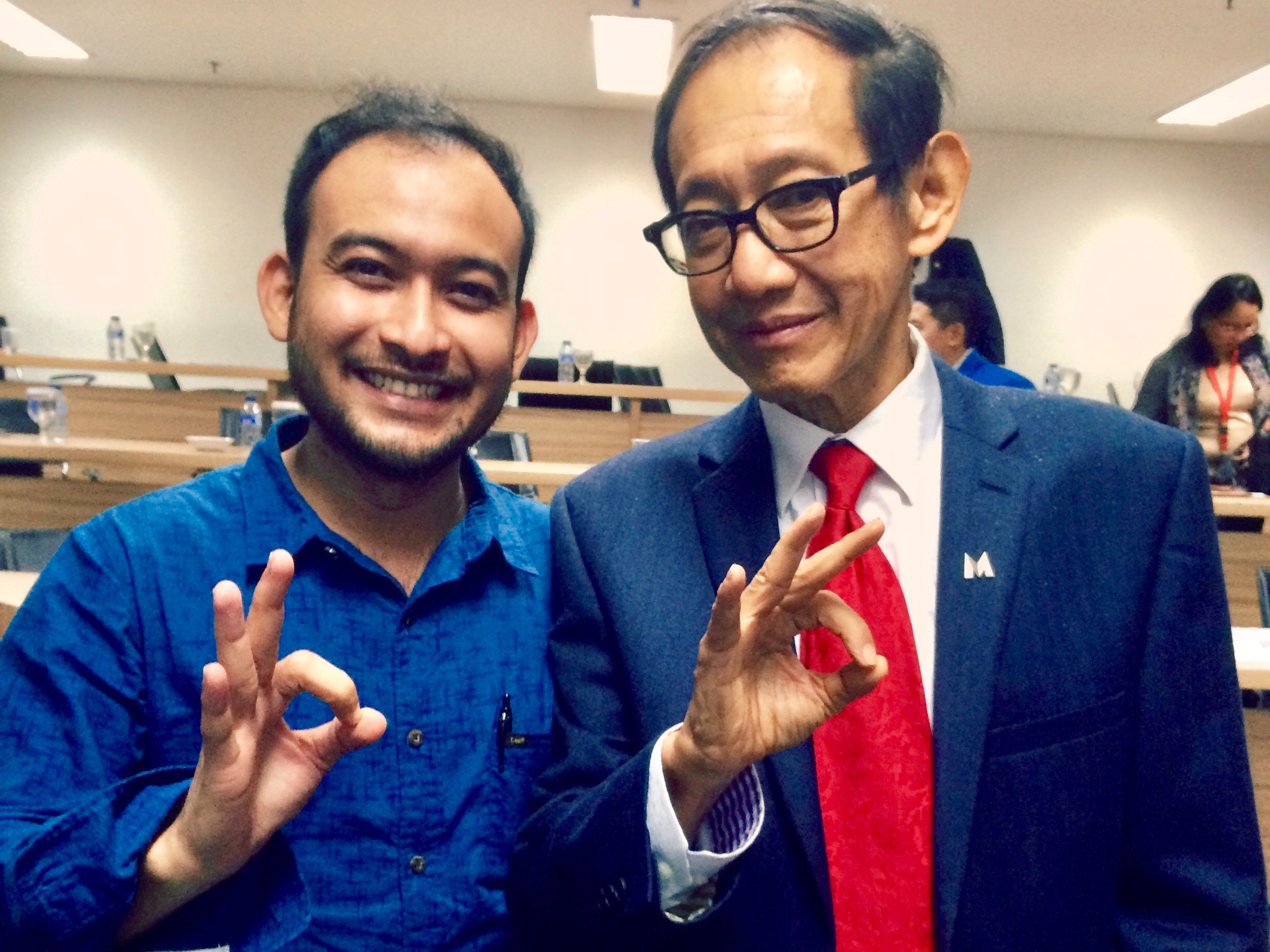
I first wrote this piece as a LinkedIn article on 13 August 2015, after attending the 2015 ICSB ASEAN Initiative, a seminar on “Innovation and Globalization in Asia” at Gedung 88 Kasablanka, Jakarta. I've rewritten it with updated context for MSME operators in Aceh today, as an introduction to the Humane Entrepreneurship concept I discuss below.
The event that day felt out of the ordinary, held in the Philip Kotler room at Gedung 88 Kasablanka, with participants from Korea, India, Taiwan, Japan, and even Europe attending the ICSB ASEAN conference. The diversity and sheer scale of the ASEAN region hold enormous appeal for all kinds of commercial interests. Almost every country in the world has a business relationship with one or more ASEAN member states.
But the non-identical conditions and difficult geography across the ASEAN region raise a challenge of their own: how to build MSMEs that are innovative and able to withstand the pressures of the global market. This isn't easy work, but leaving it unsolved will only make things worse.
2015 ICSB ASEAN Initiative put on this seminar to offer an initial outlook, ideas, and various models for charting a roadmap so ASEAN MSMEs could grow and move up to become major global players, following the example set by South Korea, Taiwan, and Singapore: transforming from developing nations into advanced economies within their respective regions.
Humane Entrepreneurship
One of the models discussed that day was The Humane Entrepreneurship (Kewirausahaan Manusiawi). The concept is simple but fundamental: businesses must be able to adapt to human needs, and conversely, people are encouraged to be able to adapt to the dynamics of the business world. This concept was first declared globally by the International Council for Small Business (ICSB) in 2016, with the aim of aligning the creation of economic wealth with the creation of quality jobs and social welfare.
The key to this model lies in the synergy between Human Capital and Economic Knowledge — in practice, Human Capital doesn't simply treat employees as a resource or a tool of production, but as a center of innovation and value creation. Kim, El Tarabishy, and Bae (2018), in the Journal of Small Business Management, describe Humane Entrepreneurship as a merger of conventional entrepreneurial orientation with an orientation toward people, employees, and society, which ultimately gives rise to Economic Knowledge: competitive advantage that grows out of human innovation and creativity itself.

These two elements can't stand alone. Both must be rounded out by ethics and ecosystem. Ethics ensures that no business decision violates human rights, damages the environment, or manipulates the market. Ecosystem provides the social and institutional infrastructure that lets that growth happen in a healthy way.
Ecosystem itself, with the society variable embedded in it, became a heated and lengthy topic of discussion at that forum. It's never easy dealing with a society whose expectations keep evolving. But there's one fundamental realization I brought home from that forum: a business is built by taking something from society and the environment, whether that's natural resources, public infrastructure, or people's time and labor. Because of that, it's only right that some portion be given back to society.
This line of thinking, I only realized later, aligns with the Creating Shared Value (CSV) theory put forward by Porter and Kramer (2011) in the Harvard Business Review. CSV emphasizes that a company's competitiveness and the health of the surrounding community are tightly interdependent. Giving value back to society, then, is no longer just a reactive charity or CSR activity, but a core business strategy that guarantees the company's own sustainability.
The 3F Principle: Fluid, Flexible, Fast
To be able to adapt to a fast-changing market and society, the forum recommended applying three principles, the 3F: Fluid, Flexible, and Fast.
Fluid. A business must not be structurally rigid. Like water, an organization must be able to flow and take the shape of its container or the conditions of its time, breaking down convoluted bureaucracy and building a culture of cross-departmental collaboration.
Flexible. In the face of economic shocks or shifting social trends, business strategy must be supple. I later found the academic term for this, Dynamic Capabilities, from Teece (2010) in Long Range Planning, which states that a company's survival depends heavily on its ability to reshape and reconfigure its assets and core competencies when facing a turbulent environment (VUCA: volatility, uncertainty, complexity, ambiguity).
Fast. Speed in making decisions and executing ideas is the currency of the digital era. Organizations must be able to read societal and market data in real time, then respond with a fit-for-purpose solution, before losing momentum.
10 Years of the ICSB ASEAN Initiative: Aceh Today
A decade after that forum, I find this 3F principle only more relevant, not less. When we designed RAMPAGOE to weave together Aceh's MSMEs from 23 districts/cities that had until then been operating on their own, the core challenge was exactly the same: how to build an ecosystem fluid enough to hold a diversity of products, flexible enough to accommodate businesses of different scales, and fast enough to respond to a market moving far more dynamically than it did in 2015.
The difference is that today we have more tools to make it happen, from sharia financing, digital market access, all the way to cross-BUMD collaboration. What hasn't changed is the underlying principle: the business that survives isn't the biggest one, but the most humane and the quickest to adapt. The business that lasts longest, in the end, is the one that most humanizes people, both the people who are its internal resources and the people who are its partners and community.
Sumber dan rujukan ilmiah:
- Kim, K. C., El Tarabishy, A., & Bae, Z. T. (2018). Humane Entrepreneurship: How Focusing on People Can Drive a New Era of Wealth and Quality Job Creation in a Sustainable World. Journal of Small Business Management, 56(sup1), 10-29.
- Porter, M. E., & Kramer, M. R. (2011). Creating Shared Value. Harvard Business Review, 89(1/2), 62-77.
- Teece, D. J. (2010). Business Models, Business Strategy and Innovation. Long Range Planning, 43(2-3), 172-194.
Leave a Reply