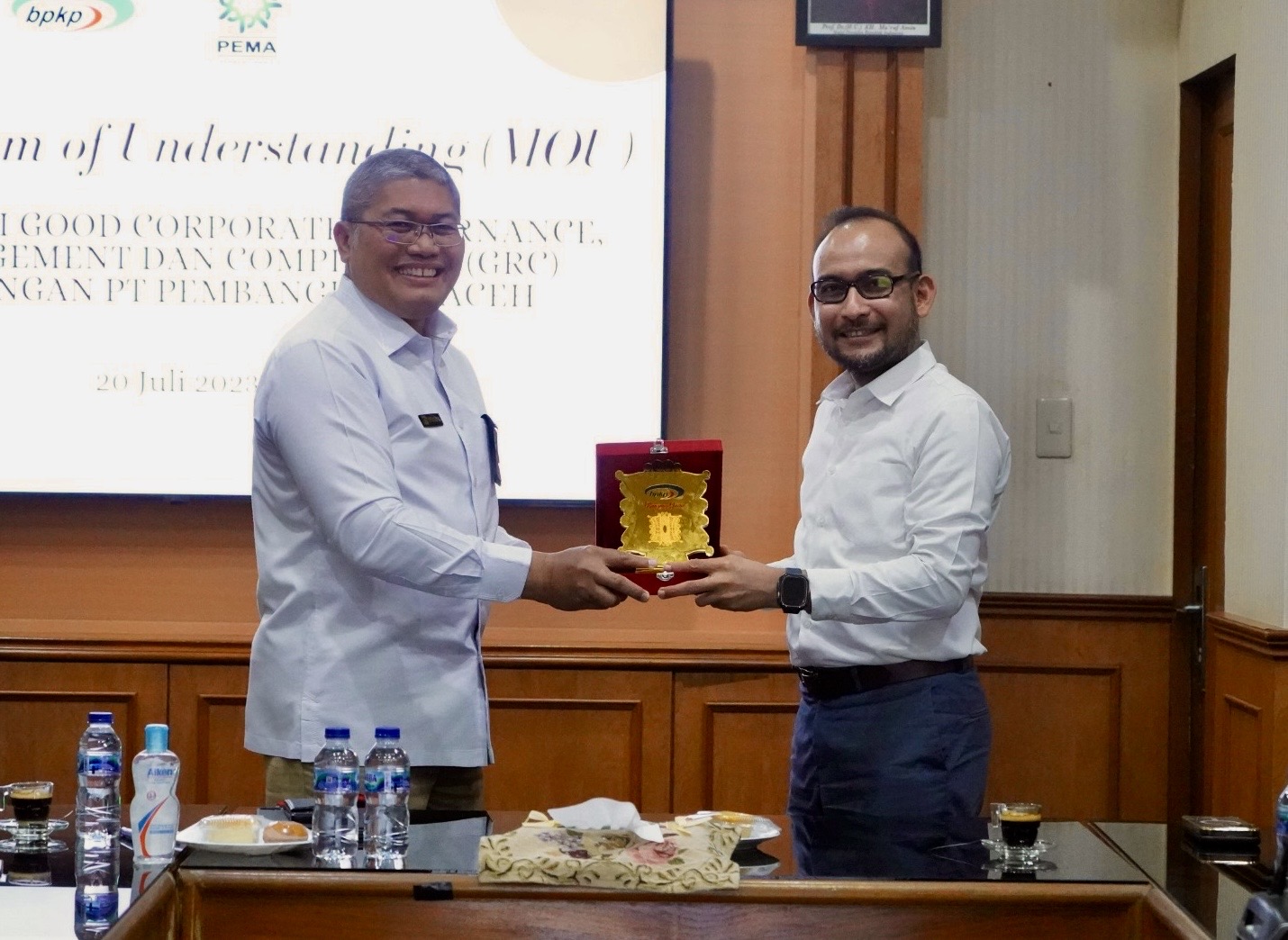
Kiri ke kanan: Supriyadi (BPKP Perwakilan Aceh), Ali Mulyagusdin — penandatanganan MoU Good Corporate Governance, Risk Management, dan Compliance (GRC) antara BPKP Perwakilan Aceh dan PT Pembangunan Aceh, 20 Juli 2023.
AIL1There's a line I've heard repeated by colleagues in the public accounting profession: an unqualified opinion (Wajar Tanpa Pengecualian) is not a certificate of corporate health. It's simply a statement that the financial statements were prepared according to standard. Whether the money was actually managed properly is a separate matter, one that often only surfaces once a compliance auditor or the BPK (Audit Board) digs deeper than the opinion itself.
That line is especially relevant for reading two events that, by coincidence, occurred close together during the first half of 2026. First, in Jakarta: on 24 February, the Daya Anagata Nusantara Investment Management Agency (Danantara) turned one year old since its inauguration by President Prabowo Subianto, and a number of academic and journalistic evaluations began dissecting what had actually changed.¹ Second, in Banda Aceh: two weeks earlier, the BPK's Aceh Representative Office submitted a 99-page Compliance Audit Report, Number 25/T/LHP/DJPKN-V.BAC/PPD.03/01/2026, on the operations of one of Aceh's diversified-business BUMDs (regional state-owned enterprises) covering 2024 through the first half of 2025. Two institutions, two levels of government, one and the same question: once the audit has spoken, who's actually listening?
I'm not writing this as an outside observer. My background in accounting and corporate governance makes opening the ledgers and running the numbers a reflex. So that's how this article is built: not an emotional opinion piece, but a reading of the numbers one by one, toward an end goal I think we can agree on: Aceh needs BUMDs that actually work, not ones that merely pass an audit opinion, let alone merely survive unchecked public opinion.
What's Changed at Danantara, and What Hasn't

Let's start with the most basic fact. Danantara consolidates more than 1,000 state-owned enterprises and their subsidiaries, previously scattered under the coordination of different technical ministries, into a single superholding structure, with a rationalization target of around 300 companies.³ Its projected total assets under management are around US$900 billion, placing it among the world's largest sovereign wealth funds, albeit with a far smaller initial capital base (around Rp320 trillion) relative to the scale of assets it consolidates.⁴
The market's reaction to its launch, frankly, wasn't encouraging. A week after the inauguration, the Composite Stock Price Index (IHSG) fell 7.1 percent, driven by roughly US$622.7 million in foreign capital outflows. That's not a sign of failure. Markets often react negatively to structural uncertainty rather than to substance, but it was an early indication that investor confidence in Danantara's governance hadn't simply materialized on its own.
The most legally substantive issue turns out not to be the asset consolidation at all, but the fight over the boundaries of immunity for its officials. An early draft of Law Number 1 of 2025 had exempted Danantara's organs from state-official status and granted them legal immunity, a provision that sparked public concern over what a number of academics called “structured impunity,” and which ultimately led to a judicial review at the Constitutional Court through Case Number 44/PUU-XXIII/2025. Lawmakers responded with Law Number 16 of 2025, which restored good-governance obligations and affirmed that Danantara's organs remain subject to criminal law in the event of an abuse of authority. In exchange, its directors gained protection through the doctrine of Business Judgment Rule: a business loss is not automatically treated as a state loss, so long as the decision was made in good faith, with reasonable prudence, and without personal conflicts of interest. BPK's audit access, importantly, was preserved, not stripped away as initially feared.
To me, this is the point that's often lost in the “Temasek-style superholding” conversation: the core of Danantara's reform isn't about the size of its assets, but about its effort to redraw the line between legal protection for business decision-makers and public accountability for public money. This is exactly the classic problem that has left many of our state and regional enterprises stuck in place: directors too defensive because a reasonable business loss can be criminalized, while real oversight of strategic decisions runs slack. Strangely enough, both failures tend to occur at the same time.
What Isn't Finished Yet, and Why It Matters
Writing Danantara up as a finished success story would be an analytical mistake. There are three areas still far from settled, and each offers a different lesson from the points above.
First, a conflict of interest at the leadership level. Danantara's CEO, Rosan Perkasa Roeslani, is a former chair of Prabowo's campaign team who now also serves as Minister of Investment and Downstream Development, a position that structurally combines the roles of investment regulator and investment manager in one person. Its Chief Investment Officer, Pandu Patria Sjahrir, has close ties to National Economic Council Chairman Luhut Binsar Pandjaitan, who, although he has stepped down from a position at a major energy company, still holds shares in the same sector. Compare this with the Indonesia Investment Authority (INA), Indonesia's earlier-established sovereign wealth fund, which is so far seen as more compliant with the Santiago Principles (the international governance standard for sovereign wealth funds): its regulations require five directors with purely professional backgrounds. Danantara, by contrast, requires a minimum of only three professional directors, and in practice two of its directors concurrently hold active government positions.¹⁰
Second, the depth of its own governance regulation is being questioned. Analysis from East Asia Forum notes that about 80 percent of the content of Government Regulation Number 10 of 2025, the implementing regulation meant to spell out Danantara's governance mechanisms, essentially repeats the text of Law 1/2025, without substantive elaboration on a risk management or investment framework.¹¹ INA explicitly applies a model of three lines of defence and ESG principles; Danantara's risk approach, as of this analysis, has not been made public, a problem made more serious by its dual role as both an investment holding and an operating entity, which leaves the state-owned banks under it exposed to funding-related activity from the investment side.
Third, and this is the easiest to verify with numbers, its financial performance targets are far more ambitious than the current trend. Collective state-owned enterprise profit actually fell from Rp327 trillion in 2023 to Rp304 trillion in 2024, as presented at a public discussion forum held by the Nagara Institute in Makassar in April 2026. President Prabowo's target for collective SOE profit under Danantara in 2026 is Rp350-360 trillion. That's not an incremental growth target; it's a radical one, assuming a reversal from two straight years of decline into growth of more than 15 percent in a single year. Bright Institute senior economist Awalil Rizky has openly called the Danantara concept still premature, arguing that basic information such as the assets managed and the projects being run remains hard for the public to access, including how it's positioned within the Central Government Financial Statements. On the other hand, KPPU Chairman Syarkawi Rauf has a supporting argument: Indonesia needs around US$650 billion in investment to hit an 8 percent growth target, and Danantara's structural flexibility was designed precisely to help close a gap that size. Both arguments stand on data, and both need to be held at the same time.
So here's the takeaway from this section: Danantara's first year is the record of an institution correcting itself under pressure, judicial review, international media criticism, academic forums, not an institution designed perfectly from the start. What makes it worth studying isn't its end result, which doesn't exist yet, but its pattern of correction: when public pressure exists and audit access isn't revoked, improvement can happen within months.
Aceh: Not an Isolated Case

The question now: does that “fast correction under pressure” pattern also hold for BUMDs in Aceh? To answer that, I need to show two data points, not one, to make clear this isn't a coincidence.
The Aceh government itself just earned its eleventh consecutive unqualified opinion on its 2025 Financial Statements.¹⁵ But as the principle I mentioned at the start of this piece goes: a WTP opinion assesses compliance in preparing the statements against accounting standards, not the effectiveness of budget management on the ground. The BUMD issues I'll lay out below need to be read in that context, not as an anomaly amid an otherwise-perfect Aceh fiscal governance record, but as a reminder that an administrative label and operational reality don't always move together.
It's worth noting that this BUMD oversight structure is actually already regulated in fairly fine detail at the national level. Government Regulation Number 54 of 2017 on Regional Government-Owned Enterprises establishes a Board of Supervisors/Commissioners as a mandatory part of BUMD governance, and Minister of Home Affairs Regulation Number 37 of 2018 goes further: regional government officials may fill Commissioner seats, with priority given to officials who carry out evaluation, guidance, and oversight functions for BUMDs. In practice in Aceh, this seat is usually filled by the Aceh Secretariat's Bureau of Economic Affairs. In other words, a formal oversight channel from the regional government to the BUMD already exists in law. The question raised by the BPK findings above isn't the absence of an oversight structure, but its effectiveness: whether the oversight seat, filled as the rules require, is actually performing a preventive function, or is merely a structural compliance formality.
The first case: the Aceh diversified-business BUMD that was the subject of that BPK audit report dated 10 February 2026. The most striking ratio: operating expenses against operating revenue reached nearly 195 percent in 2024; recorded expenses of Rp33.9 billion against operating revenue of only Rp17.4 billion.¹⁶ Without dividend injections from its oil-and-gas subsidiary, the company's core business, selling off ancillary assets and leasing out facilities, proved unable to cover its own operating costs. The BPK also found the wrong accounting standard being applied: the company still uses SAK ETAP (the standard for entities without significant public accountability), even though the scale and strategic nature of its business should place it under full PSAK. As a result, items such as CSR spending, bonuses, production services, and pre-investment costs were recorded as reductions to equity rather than as expenses on the income statement, a classification error that could require 2024 net profit to be revised down by as much as Rp20.2 billion.¹⁷ This isn't just an administrative compliance issue. It's about earnings quality, reported profit that doesn't reflect actual economic substance, exactly the kind of deficiency that, in audit language, is called a material weakness in internal control. Beyond that, two joint operation schemes, one of them in the fisheries sector, were recorded as running losses with a combined value of around Rp2.82 billion, while another joint-operation scheme in the coffee sector remains at risk of not recovering around Rp1.24 billion in receivables and remaining funds; 78 experts were recruited without clear job descriptions or workload analysis; the employee bonus mechanism relies entirely on the board's subjective judgment with no measurable performance indicators; and one asset revitalization project has been dragging on indefinitely, with a potential loss of around Rp10.1 billion because it has no assured funding source.¹⁸
The second case, and this is what convinces me this issue is systemic, not a one-company coincidence: a BUMD owned by the Sabang City Government. The Amanat Bulan Bintang Berkarya (ABBB) faction in the Sabang City Council recorded consecutive losses since its early years of operation, around Rp444 million in the first year, rising to around Rp473 million in 2024, against an initial paid-in capital of Rp2.5 billion injected by the Sabang City Government in 2022. The ABBB faction has openly recommended a full management evaluation, including the option of freezing or dissolving the company if no meaningful improvement follows.
Two cases, two different business sectors, one and the same pattern: the core business doesn't generate enough revenue to cover its own costs, financial reporting standards are inadequate for the scale and risk of the business, and internal oversight isn't functioning as an early-warning system. None of these findings involves the complexity of the Business Judgment Rule doctrine or a constitutional judicial review. This is a basic corporate financial management problem which, precisely because of its simplicity, should be easier to fix than overhauling the national state-owned enterprise architecture.
What's Worth Adapting, and What Isn't
The first instinct on reading Danantara's story is to picture a miniature version for Aceh, a kind of small superholding uniting all the province's BUMDs and their subsidiaries into a single structure. That temptation, it turns out, needs to be resisted, because it's a category error. Danantara consolidates assets equivalent to seven giant state-owned enterprises with full presidential political backing, and still faces serious governance problems at its own level. Provincial or district/city BUMDs operate at an asset scale that's an entirely different order of magnitude, with far more limited DPRA/DPRK (provincial/city legislature) and APBD/APBK (regional budget) oversight capacity. Copying its scale and structural ambition risks repeating the same weaknesses without the institutional capacity to handle them.
What's worth adapting isn't the scale, but the framework of thinking. First, a clear, verifiable separation between oversight and execution functions, not just a commissioner's seat as an honorary post, but a documented, active oversight obligation, paired with proportional protection for directors who make business decisions in good faith. Second, the “three fences” framework now being drafted in the State Finance Bill, budget documents required to reflect state/regional rights, expanded audit access to transaction effectiveness (not just administrative compliance), and legislative approval for material decisions, could be adopted directly into a Qanun (Aceh regional bylaw) or Governor's Regulation on BUMD oversight, without waiting for a law revision at the central level. Third, and this is the cheapest to implement: migrating the accounting standard from SAK ETAP to one proportional to the business's actual scale and risk. This isn't a years-long institutional reform project. It's a technical decision that can be executed within a single annual reporting cycle, if there's the will at the board and shareholder level.
What shouldn't be copied is just as clear: holding both an oversight role and an active executive function at once, and concentrating power in a single figure without an independent system of checks and balances. Ironically, this is precisely the part of Danantara most criticized by public policy analysts themselves, including two researchers from Laboratorium Indonesia 2045 writing in East Asia Forum. If Aceh's BUMDs want to learn from Danantara, the right lesson to take is from the part it's currently correcting, not from the part observers are currently raising concerns about.
Closing
The table below summarizes both stories side by side, not to equate their scale, which is clearly worlds apart, but to show that both face the same basic question: is a publicly owned business entity managed as an instrument of economic value creation, or as a patronage space that merely happens to hold corporate legal form?
| Dimension | Danantara (national) | Aceh BUMDs (two cases) |
|---|---|---|
| Assets under management | ~US$900 billion | Billions to tens of billions of rupiah |
| Expense-to-revenue ratio | ROA target 7%; SOE profit fell 2023→2024, 2026 target up >15% | ~195% (Case 1); admin expenses >6x revenue (Case 2 / PT PSM) |
| Main governance issue | CEO/CIO dual roles, implementing regulation with minimal substance | Wrong accounting standard, staff without job descriptions, capital eroded |
| Correction mechanism already underway | Constitutional Court judicial review, Law 16/2025 revision, State Finance Bill | BPK audit report, recommendations to the Board; Council proposes dissolution option |
SOE reform in Jakarta is far from perfect, and this piece isn't meant to hold it up as a blueprint to be copied wholesale. Some parts of it are, in fact, examples of what to avoid. But there's one thing worth taking away, and I think it's the most important one: the lesson isn't about how big Danantara is, but about a public institution's willingness to be corrected once its own audit has shown exactly where the problem lies. The BPK audit reports on the two Aceh BUMDs I've laid out above are, in effect, an opportunity equivalent to the one Danantara responded to through Law 16/2025. The only difference: one was responded to within months, under national scrutiny and constitutional review; the other is still waiting to see whether it will be met with the same seriousness, far from that spotlight. A more advanced Aceh isn't an Aceh free of audit findings. No institution anywhere is like that. A more advanced Aceh is one where audit findings genuinely become the start of improvement, not the end of a report left on a shelf.
Sumber dan rujukan:
- Agustinus Rangga Respati dan Erlangga Djumena, “Refleksi Satu Tahun Danantara, Langkah Reformasi dan Efisiensi BUMN,” Kompas.com, 26 Februari 2026; Paulus Aluk Fajar Dwi Santo, “Satu Tahun Danantara: Evaluasi Reformasi Pengelolaan BUMN,” Business Law Binus, 5 Maret 2026.
- Badan Pemeriksa Keuangan RI Perwakilan Aceh, Laporan Hasil Pemeriksaan Kepatuhan Nomor 25/T/LHP/DJPKN-V.BAC/PPD.03/01/2026, 10 Februari 2026; Biro Administrasi Pimpinan Setda Aceh, “Terima LHP BPK, Asisten Sekda Aceh Tekankan Akuntabilitas Belanja Daerah,” humas.acehprov.go.id, 12 Februari 2026.
- Paulus Aluk Fajar Dwi Santo, op. cit., bagian D.
- “Resmi Diluncurkan, Ini 7 Daftar BUMN yang Asetnya Akan Dikelola Danantara,” Kontan.co.id, 24 Februari 2025; “Danantara Diluncurkan 24 Februari, Bakal Kelola Aset US$980 Miliar,” DDTC News.
- Baginda Muda Bangsa dan Reyhan Noor, “Governance Risks Plague Indonesia’s New Sovereign Wealth Fund,” East Asia Forum, 8 April 2025.
- Mahkamah Konstitusi RI, Putusan Perkara Nomor 44/PUU-XXIII/2025; Nora Galuh Candra Asmarani, “UU 1/2025 Resmi Diteken, Atur Pembentukan dan Wewenang BPI Danantara,” DDTC News, 26 Februari 2025.
- Paulus Aluk Fajar Dwi Santo, op. cit., bagian F (“Business Judgment Rule dan Imunitas”).
- Baginda Muda Bangsa dan Reyhan Noor, op. cit. (data CEO/CIO, perbandingan dengan INA, Prinsip Santiago, struktur direksi).
- Baginda Muda Bangsa dan Reyhan Noor, op. cit. (analisis PP No. 10/2025 dan model three lines of defence INA).
- AFU.id, “Danantara: Antara Harapan Pertumbuhan Ekonomi dan Risiko Tata Kelola,” 15 April 2026.
- Awalil Rizky (Bright Institute), dikutip dalam AFU.id, op. cit.
- Syarkawi Rauf (Ketua KPPU), dikutip dalam AFU.id, op. cit.
- “Pemerintah Aceh Raih WTP ke-11 Berturut-turut dari BPK RI,” Serambinews.com, Juni 2026.
- Badan Pemeriksa Keuangan RI Perwakilan Aceh, LHP Kepatuhan No. 25/T/LHP/DJPKN-V.BAC/PPD.03/01/2026, sebagaimana dirangkum dalam “Rapor Merah PT XXXX: Audit BPK Bongkar Kerapuhan Keuangan, Investasi Gagal, hingga ‘Gimmick’ Laba,” Pintoe.co, 1 Juli 2026, dan “Temuan BPK Kinerja PT XXXX Buruk ‘BUMD Aceh Diambang Krisis Tata Kelola’,” Harian Reportase, 2 Juli 2026.
- “Fraksi ABBB Soroti PT PSM, Nilai BUMD Sabang Gagal dan Usulkan Opsi Pembubaran,” AJNN.net, 14 Juli 2026.
- Baginda Muda Bangsa dan Reyhan Noor, op. cit.
- Peraturan Pemerintah Nomor 54 Tahun 2017 tentang Badan Usaha Milik Daerah, Pasal 39 dan Pasal 58; Peraturan Menteri Dalam Negeri Nomor 37 Tahun 2018 tentang Pengangkatan dan Pemberhentian Anggota Dewan Pengawas atau Anggota Komisaris dan Anggota Direksi Badan Usaha Milik Daerah, khususnya Pasal 15 ayat (4) dan (5) mengenai unsur pejabat Pemerintah Daerah dalam keanggotaan Dewan Pengawas/Komisaris.
Leave a Reply