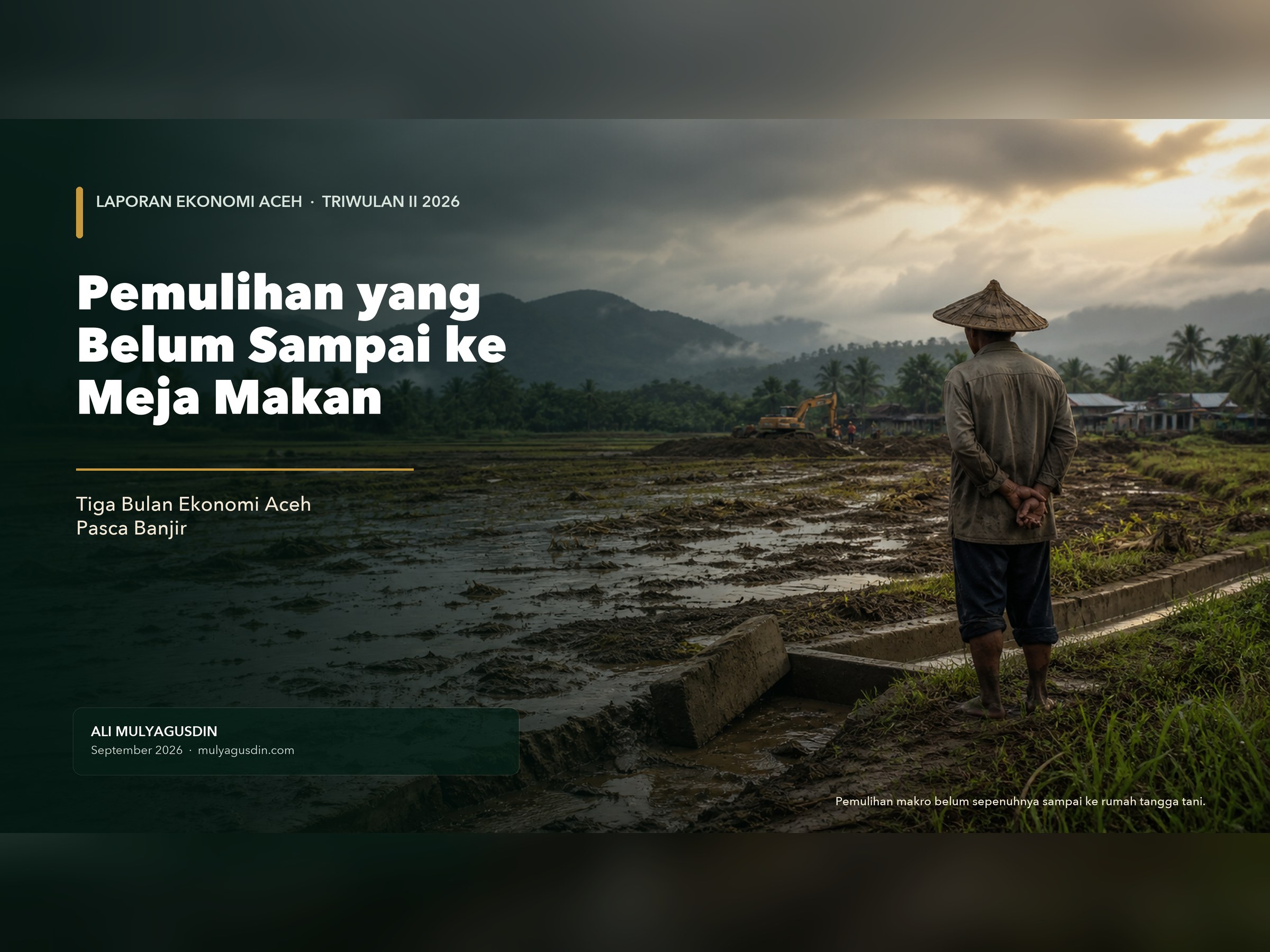
Aceh’s economy grew 4.86 percent in the second quarter of 2026. Cumulative growth in the first half reached 4.48 percent, while June exports jumped 61.31 percent. The government has reason to celebrate.
Yet in March 2026, the number of poor people in Aceh actually rose by 10,400.
That poverty figure has not been updated since March. So the more important question now is not whether Aceh’s economy has grown. The answer to that is clear. The question is whether the recovery has reached households, or whether it stops at the statistics.
Pressure on households also comes from the rising cost of living. As prices climb, many families are still dealing with job losses and the disruption of economic activity caused by the disaster.
That is where the gap between an economic rebound and household welfare starts to show.
The Regional Secretary of Aceh called the result an “acceleration” and a “positive signal”. The government also pointed to a number of other indicators, from rising exports and public mobility to tourism activity.
But a speech about economic recovery is not enough if it only talks about growth. Poverty and labour market conditions have to be read as well, because that is where the impact of growth is actually felt.
The Regional Secretary himself has said that growth must reach the public, and named MSMEs as one of his concerns. So the issue is not whether the intention exists. The issue is whether that growth genuinely produces better income for families in Aceh.

A real rebound, but an uneven labour market recovery
Any criticism of Aceh’s economic recovery has to begin by acknowledging that improvement is real.
Annual growth moved from 4.82 percent to 4.86 percent, an increase of only 0.04 points. Calling that annual gain an acceleration sounds larger than the numbers themselves.
The more noticeable change appears on a quarterly basis. Aceh’s economy grew 3.77 percent in the second quarter after contracting 0.61 percent in the first quarter of 2026. In nominal terms, gross regional domestic product rose from Rp66.39 trillion to Rp69.69 trillion.
The labour market has indeed started to move, but the improvement is not spread evenly. The total number of people in work rose by about 15 thousand. The share of formal workers climbed 2.03 points, while underemployment fell 1.21 points.
Agriculture moved in the opposite direction. Its share of the working population fell from 41.39 percent in February to 39.31 percent in May. The number of workers in the sector dropped from around 1.035 million to 989 thousand, a loss of roughly 46 thousand workers in just three months.
That figure matters because agriculture is still the largest employer in Aceh. The additional jobs created during the recovery period have not been enough to offset job losses in the sector that provides income for the largest share of working households.
The rebound is real. The labour market also shows improvement on several indicators. But farming households are still losing work, and that is where the problem with Aceh’s recovery becomes clearer.
But the engine is firing in the wrong sectors for households
The direction of growth offers a clue as to why improvement at the household level feels slower.
Construction grew 13.36 percent year on year. Financial services grew 12.32 percent. Both sectors lifted gross regional domestic product, but Aceh’s employment structure tells a different story. About 39.31 percent of working people are still in agriculture.
Agriculture has the largest workforce base, yet over the same period it lost around 46 thousand workers. That contradiction cannot be separated from rice fields that have not returned to production after the disaster.
Part of the second quarter’s economic activity also came from seasonal spending. There was Eid al-Adha, holiday allowances, the thirteenth month salary for civil servants, cement demand for reconstruction, and post flood assistance. Money circulated faster, but that circulation does not necessarily create steady jobs with income that households receive every month.
The June export surge also needs a closer reading. The dominant commodities are coal, CPO, and coffee. Export value can jump when shipment volumes rise, but raw commodities leave less room for added value in Aceh than processed products do.
This is where the downstream processing agenda the government talks about is tested. If raw materials leave in unprocessed form, part of the production process and the added value happens outside Aceh. The effect on local job creation is also smaller than if processing were done in the region.

The latest welfare figures are still frozen at their lowest point
Another issue is the timing of measurement. The data being compared come from three different periods.
Poverty was measured in March. Employment data reflect conditions in May. Second quarter economic growth covers April to June.
So we cannot yet say that second quarter growth has reduced poverty in Aceh. BPS has not measured poverty again since the growth recorded in the second quarter. The next release is expected to give a picture only around January 2027.
The honest position today is that the impact has not been measured.
In March 2026, the number of poor people in Aceh rose by 10,400. That figure is the net change in the poor population. It does not mean that 10,400 people who were previously above the poverty line all fell into poverty during that period.
Pressure on households also built when inflation in Aceh reached 6.94 percent in February 2026. That was the highest inflation rate in the country that month, in the context of the removal of the electricity tariff discount. When living costs rise while household income sources are disrupted by disaster, some families become more vulnerable to falling below the poverty line.
Ada juga sisi yang membaik. BPS mengukur jumlah orang miskin sekaligus seberapa dalam dan seberapa parah kemiskinan mereka, dan kedua ukuran itu justru menurun. Seberapa jauh rata-rata pengeluaran penduduk miskin dari garis kemiskinan turun dari 2,055 menjadi 1,961, sedangkan ketimpangan di antara sesama penduduk miskin turun dari 0,523 menjadi 0,460. Ini berarti persoalannya bukan kemiskinan yang semakin dalam pada kelompok yang sudah miskin, tetapi bertambahnya jumlah orang yang masuk ke bawah garis kemiskinan. Jurangnya tidak bertambah dalam, tetapi jumlah orang yang jatuh ke dalamnya bertambah.
Full report: Three Months of Aceh’s Economy After the Flood
Complete BPS and Ministry of Agriculture data with charts, a table of rice field damage by district, a glossary, and a source for every figure. 21 pages.
Open the download pageRoots still waterlogged: only 1 percent of the rice fields replanted
Agricultural recovery data give a more visible picture of why households have not recovered quickly.
As of 5 August 2026, the Ministry of Agriculture recorded 57,171 hectares of rice fields affected by the disaster across 19 districts and cities in Aceh. The government is targeting the rehabilitation of 40,691 hectares.
By that date, construction work had reached only 18 percent. Just 373 hectares had been replanted, roughly 1 percent of the rice field area targeted for rehabilitation.
That 1 percent helps explain why a recovery in gross regional domestic product has not automatically become a recovery in household income. Rice fields that cannot be planted mean farmers are not producing. Farm labourers lose working days. Traders of farm produce, millers, transporters and village shops also lose the income that circulates among them.
This is where two sets of data that first looked unrelated meet. The May labour report recorded a loss of around 46 thousand workers in agriculture. Ministry of Agriculture data show only 1 percent of the rice field rehabilitation target has been replanted. When productive land has not recovered, job losses in agriculture are not surprising.
As long as the rice fields have not recovered, the sector that absorbs about four in every ten workers in Aceh has not returned to normal either. Economic recovery can show up in gross regional domestic product while the recovery of farming households remains stuck in the field.

The bridge that has to be built quickly: MSMEs
Aceh needs a more direct route from economic growth to household income. This is where MSMEs should be given a larger place.
Bank Indonesia data show that QRIS transactions in Aceh grew 153 percent to Rp2.7 trillion between January and May 2026. The number of transactions reached 33.5 million, across 301,998 merchants.
These numbers show that the public and business operators have adopted digital payments quickly. But QRIS only provides a means of transaction. More transactions do not automatically mean higher trader income or lower poverty.
What flows into food stalls, shops, food vendors, home businesses and services has to be more than payment frequency. Business operators need capital to buy materials, add stock, improve production and take on larger orders.
Bank Aceh’s people’s business credit quota of Rp1.5 trillion for 2026 should be part of that process. Its disbursement needs to be directed to businesses that genuinely generate turnover and jobs, especially in areas whose economies have not recovered from the disaster.
The government has already made MSMEs a priority. The measure now is simple. How many businesses receive credit, how many see turnover rise, how many new workers are hired, and how many businesses manage to enter wider markets.

Aceh’s economic recovery will not be judged by how high gross regional domestic product is in a single quarter. The harder measure is whether the poverty figure falls at the next measurement, whether the rice fields are replanted, and whether agriculture again absorbs workers in large numbers.
Economic growth means something when its results reach family income. In Aceh, the final measure is not simply an economy that grows, but households that can once again meet their needs with more certain earnings.

Sources and References
- Statistics Indonesia Aceh Province: economic growth for the second and first quarters of 2026, the March 2026 poverty profile, the May 2026 employment situation, and inflation releases.
- Ministry of Agriculture of the Republic of Indonesia: progress on the recovery of disaster affected rice fields in Aceh, as of 5 August 2026.
- Bank Indonesia Aceh Representative Office: QRIS transaction developments in Aceh, January to May 2026.
- Bank Aceh Syariah: 2026 people’s business credit quota.
- Regional Secretariat of Aceh: “Aceh Regional Secretary: The Economy Is Strengthening, Recovery Momentum Must Be Maintained”, acehprov.go.id, 16 August 2026.
Leave a Reply